Written by: Anand Sen; Reviewed by: Dr. Nuvpreet Singh
Your brain notices it casually at first. The water bowl is exactly as full as it was this morning. By afternoon, the heat is blistering, and your AC is struggling, and your cat is sprawled out on the cool floor tiles like a carpet, refusing to move. A silent thought creeps in: “My cat hasn’t been drinking water… is that normal?”
The nostalgic Dermi Cool ad has started playing, and with temperatures crossing 42°C, hydration becomes the most critical yet overlooked aspect of feline care. In fact, summer dehydration is among the most common reasons Indian pet owners reach out for veterinary advice.
Here’s the plot twist: your cat isn't acting stubborn; she’s just acting like a desert nomad. Cats have evolved from ancestors who got all their daily hydration from prey, not from standing bowls. It worked in the wild, but in your living room, with a diet of dry kibble (that lacks moisture) and an Indian summer turning your flat into an oven, it’s a recipe for disaster.
Unlike dogs, who’ll lap up anything, your cat is a connoisseur of "freshness." Maybe the water is too warm, the bowl is too close to her litter, or the chlorine taste is offending her royal palate.
This may not be an issue in the winter, but in the summer, when heat spikes, your cat’s low thirst drive is not a personality trait anymore. Signs of cat dehydration in the Indian climate move faster than Vande Bharat.
Thus, in this guide, we’ll decode the "Cat-titude" toward water and show:
- Why cats naturally drink less water
- The real reasons your cat may be refusing the bowl
- Simple at-home tests to check dehydration
- Exactly how much water your cat actually needs in Indian summer
- How to hydrate a Cat in India in Summer
Why Cats Don’t Drink Enough Water - The Biology Indian Owners Must Understand
You may assume that cats are “bad drinkers, but they are actually low-thirst animals by design. Their ancestors, the African wildcats, long survived in arid regions with a scarcity of water resources.
According to a veterinary study, instead of depending on drinking, Cats have evolved to get most of their hydration from prey, small animals which are composed of 65–75% water. Their food actually replenishes lost water from their bodies.
This evolutionary trait still exists in domesticated cats today.
But here’s the problem.
Modern cat feeding habits don’t align with this biology.
Most Indian cat owners depend heavily on dry kibble due to the advantages like convenience, cost, and availability. However, dry food contains less than 10% moisture, compared to 75–80% in wet food. This creates a big hydration gap that cats must compensate for by drinking water.
And here’s where things break down. Cats often do not compensate enough.
Studies by veterinary authorities like the Cornell Feline Health Centre state that many domestic cats live in a constant state of chronic mild dehydration, especially those on dry diets. And the interesting part is that many cat owners don’t even realise this.
Daily Water Requirement
According to feline veterinary guidelines:
- Cats need 50–60 ml of water per kg of body weight per day
For a typical 4 kg Indian cat:
- That’s 160–240 ml daily
In summer, this requirement increases by 15–25% due to:
- Heat exposure
- Respiratory water loss
- Reduced activity but increased environmental stress
- Dry diets
The Indian Context
This issue is amplified in India because:
- Dry kibble dominates Indian cat feeding habits
- Awareness of hydration needs in pet parents is low
- Many owners assume eating is equal to hydration
When a cat doesn’t drink enough water, it is not generally a behavioural flaw; it’s a biological mismatch with its environment.
9 Reasons Your Cat Is Refusing Water in the Summer Heat
Dehydration is a key part of cat nutrition. Cat nutrition and health are closely related. Most cats that “won’t drink water” are not sick; they’re reacting to something specific in their environment.
Water & Bowl-Related Causes (Most Common)
- Warm or stale water
Water heats up quickly, and just like us, cats instinctively avoid warm or stagnant water. Refresh their bowl every 3-4 hours.
- Chlorinated or hard tap water
Municipal water in our country often contains high amounts of chlorine, which cats can smell. This factor alone can reduce their will to drink significantly.
- Wrong bowl shape (whisker fatigue)
Deep, narrow water bowls press against a cat’s whiskers, causing discomfort. This is also known as Whisker fatigue, especially common in Persian cats and can be fixed by using wide, shallow bowls.
- Bowl placed near food or litter
Cats, as you know, are cleanliness freaks and avoid drinking water near food waste or litter due to their instincts to avoid contamination.
- Dirty bowl
Your cat is the “Gordon Ramsay of the animal world.” Even a thin biofilm on the bowl can deter them. Daily cleaning of their water bowl is essential.
- Only one water source
Cats generally prefer multiple drinking spots as one bowl is often not enough.
Health & Behaviour-Related Causes
- Dental pain
If your cat is approaching the bowl but refrains from drinking, it could be a sign of oral discomfort.
- Stress or environmental change
Environmental stressors like new pets, relocation or noise can influence their drinking behaviour.
- Underlying illness
Underlying health conditions like kidney disease, diabetes, or infections can alter thirst patterns in cats, either increasing or decreasing them. Dehydration could just be a sign that your pet might be hiding a health issue.
At Conbun, we recorded a 36% increase in cat dehydration consultations between April and June 2025. Veterinarians on the platform generally noticed that dirty food bowls and chlorinated water in many regions of the country, especially in South Indian states like Chennai and Kerala, are the top causes of pet cats’ refusal to drink water.
3 At-Home Tests to Check If Your Cat Is Already Dehydrated
You don’t always need hefty equipment or a clinic visit to assess your cat’s hydration. These three quick tests can give you immediate insight.
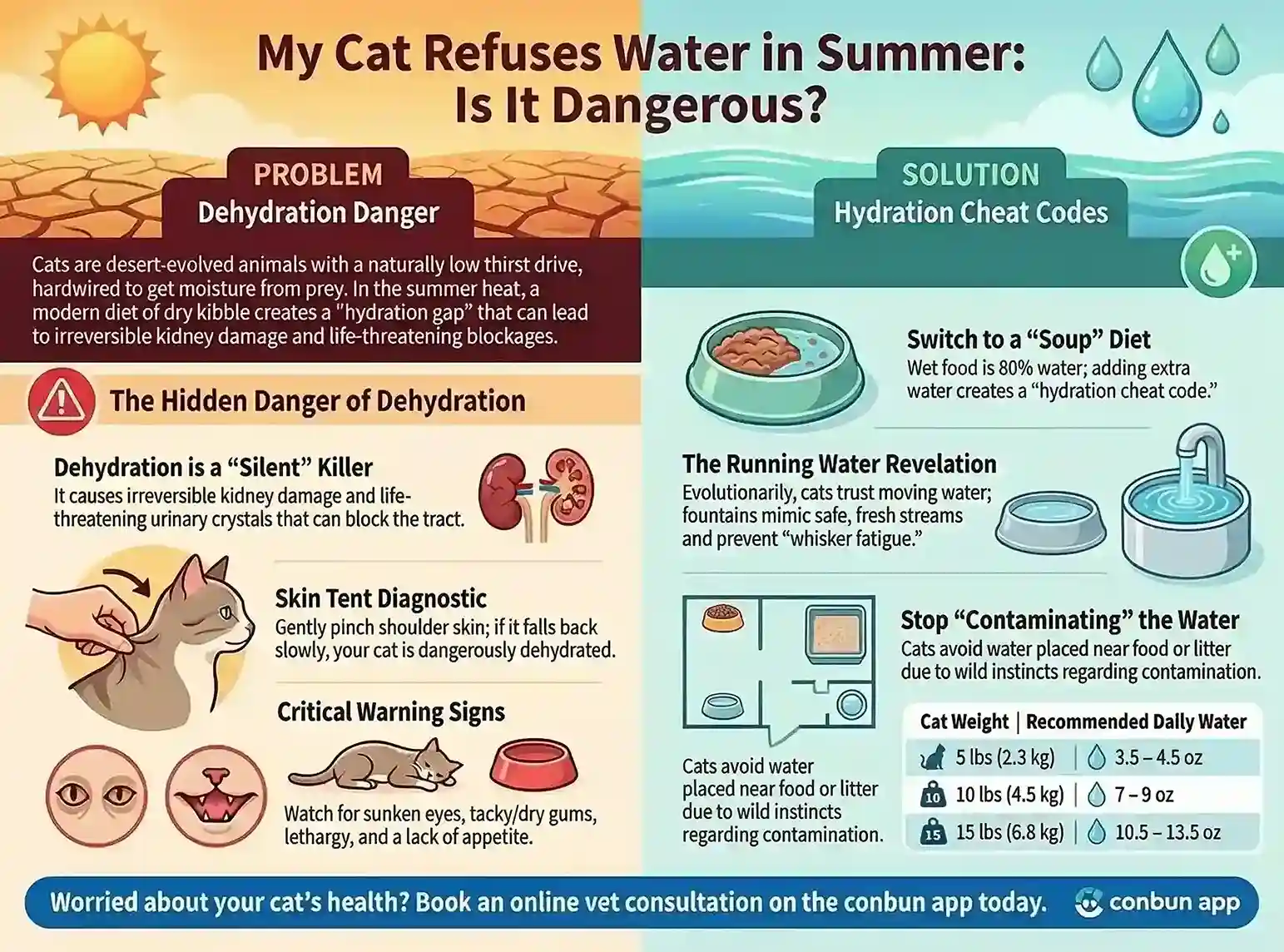
Test 1 - Skin Tent Test
Gently lift the skin between your cat’s shoulders and release it.
- Normal: snaps back instantly
- Mild dehydration: slow return (2–3 seconds)
- Severe dehydration: stays tented
Note: This test may be less reliable in older cats, as their skin’s elasticity is reduced due to old age.
Test 2 - Gum Test (Most Reliable)
Lift your cat’s lip and touch the gums.
- Healthy: moist, pink
- Dehydrated: dry, sticky
- Capillary refill time: press and release
- Normal: 1–2 seconds
- Delayed: 2+ seconds
Pale or grey gums are the top cat dehydration symptoms in India and signal an emergency.
Test 3 - Eye Test
Observe your cat’s eyes in natural light.
- Hydrated: bright, moist
- Dehydrated: dull, sunken
Sunken eyes indicate moderate to severe dehydration.
Interpretation
- All normal: hydration likely adequate
- One abnormal: early concern
- Two or more abnormal: vet consultation needed
- Severe signs: immediate medical attention (Book Conbun vet consultation immediately)
To diagnose if your cat is struggling with dehydration, talk to a vet online instantly on the Conbun app. Learn effective tips on how you can mitigate this issue and re-instil their will to drink. You can also get vet tips on cat summer care in India.
How Much Water Does a Cat Need Daily in India's Summer?
The standard guideline is simple:
50–60 ml of water per kg of body weight per day.
Practical Hydration Table
| Cat Weight | Normal Need | Summer Need (+20%) | Dry Food Only | Wet Food Diet |
| 3 kg | 120–180 ml | 144–216 ml | Full from the bowl | ~50–70 ml |
| 4 kg | 160–240 ml | 192–288 ml | Full from the bowl | ~70–90 ml |
| 5 kg | 200–300 ml | 240–360 ml | Full from the bowl | ~90–110 ml |
| 6 kg | 240–360 ml | 288–432 ml | Full from the bowl | ~110–130 ml |
Key Insight for Indian Cat Owners
If your cat thrives on dry kibble only, their water bowl is the primary source of hydration, and if it still refuses the water bowl, that’s a problem.
On the other hand, if your cat eats wet food, reduced drinking is normal and not a thing you should worry about.
Why Summer Increases Risk
In India:
- Indoor temperatures can reach 36-40°C without AC
- Power cuts cause sudden heat spikes
- Cats lose fluid through respiration and minimal sweating
Flat-faced breeds like Persians and Himalayans, which are the most popular cat breeds in India, are at even higher risk due to reduced heat tolerance. Their panting is less efficient, and therefore, they are less efficient at regulating body heat in comparison to other breeds.
8 Vet-Approved Ways to Get Your Cat to Drink More Water in Summer
Now, as you know, a cat refusing a water bowl is not a pet behaviour issue; let’s focus on how you can get your cat to drink more water during summer.
The good news is that you don’t need expensive solutions. Most hydration problems can be fixed with small, smart environmental and dietary changes.
1. Switch to Wet Food (Even Partially)
This one change, if done correctly, can create the biggest impact.
The Wet vs. Dry Cat food debate is ever-existing, but we know that the perfect choice depends on a cat’s lifestyle.
As per Cornell Vet Resources, wet food contains over 75% moisture, compared to just 10% in dry kibble. By replacing just one dry meal a day with wet food, you can significantly reduce your cat’s dependence on the water bowl for hydration.
This doesn’t have to be expensive for Indian households:
- One pouch per day is enough to improve hydration levels
- If your cat is picky, mix it with dry food that your cat likes
- Picky eaters can also benefit from automatic cat feeders, as they keep wet food fresh for a longer time
Think of it as giving your cat hydration through food, the way nature intended.
Also, practice portion control to avoid dehydration. Overfeeding a kitten could also significantly impact hydration, primarily by causing digestive distress that leads to fluid loss.
2. Add Water to Dry Food
If wet food isn’t feasible for you, here’s a simple trick:
Add 3-4 tablespoons of warm water to dry kibble.
This will:
- Soften the food and make it more palatable
- Increase total fluid intake
- Go unnoticed by the cat
This could be one of the easiest ways you can close the hydration gap without changing your cat’s diet completely.
3. Try a Water Fountain
Cats, due to their evolutionary instincts, prefer running water.
In the wild, still water means the risk of contamination. Flowing water is fresh and safe to drink.
A simple pet fountain can:
- Increase their water intake by 50–70%
- Keep water oxygenated and cooler, increasing thirst drive
- Encourage curiosity-driven drinking
In India, basic fountains are easily available online. You can consider them for cats that don’t like bowls.
4. Switch to Filtered Water
This is especially important for Indian cat owners.
Tap water often contains:
- Chlorine
- Dissolved salts
- Metallic taste
Cats have a very strong sense of smell compared to humans; what smells “fine” to us may be unpleasant to them.
- Offer filtered water alongside tap water
- Observe which one your cat prefers
Many owners are surprised by the difference.
5. Use Wide, Shallow Bowls
Wide, shallow bowls can be particularly important for Persian and flat-faced cats.
As discussed earlier, deep bowls can lead to whisker fatigue, which is a sensory discomfort that cat’s when whiskers touch the sides.
Solution:
- Use ceramic or stainless-steel bowls
- Wide, shallow design
- Even a flat plate will work better than a deep bowl
Sometimes, this small change can solve weeks of water refusal.
6. Place Multiple Water Stations
One bowl may not be enough for your cat.
They generally prefer:
- Multiple options
- Quiet locations
- Easy access without disturbance
Place 2–3 bowls across your home, especially:
- Near resting spots
- Away from litter boxes
- Not next to food bowls
This can increase passive drinking throughout the day.
7. Add a Flavour Boost (Safely)
Sometimes, flavour-based encouragement may help.
Add:
- A small amount of low-sodium chicken broth (no onion or garlic)
- Water from tuna in water (not oil)
This makes water more appealing to your cat as it adds both flavour and aroma to their bowl.
Important:
- Discard after 1–2 hours
- Do not overuse; this is a temporary trick, not a daily dependency
8. Use Ice Cubes as Enrichment
Temperature matters, especially in peak Indian summers, when living rooms can bake pizzas.
Adding an ice cube:
- Keeps the water cooler for longer
- Sparks curiosity
- Encourages playful interaction
Many cats enjoy licking or playing with ice. This leads to incidental hydration.
You can also use catnip to treat mild dehydration in cats. You can make a catnip tea by steeping fresh or dried leaves in hot water, then cooling it to create a scented and enticing liquid for your cat to drink.
What NOT to Do (Critical for Indian Households)
Let’s address some common but dangerous mistakes that Indian cat owners make to treat dehydration in cats:
- Do NOT give ORS (Electral, Pedialyte): These are solutions formulated for humans and can harm cats
- Do NOT force water using a syringe: Can lead to aspiration into the lungs
- Do NOT give milk: Most adult cats are lactose intolerant, which worsens dehydration and can lead to gastrointestinal distress.
When Is It a Medical Emergency - Could Dehydration Signal Something Worse?
Here’s an uncomfortable truth. Sometimes, dehydration may not be the problem. It’s the symptom of an underlying health condition.
If you notice that your cat has suddenly changed their drinking behaviour, it may signal a condition that is linked to dehydration.
Cat health problems linked to dehydration
| Condition | Drinking Pattern Change | Other Signs | India Relevance |
| Chronic Kidney Disease (CKD) | Initially increased thirst, then stops | Weight loss, bad breath, vomiting | Very common in senior Indian cats (8+ years) |
| Diabetes | Dramatically increased thirst | Weight loss despite a good appetite | Rising with high-carb dry food diets |
| Hyperthyroidism | Increased thirst + restlessness | Weight loss, hyperactivity, vomiting | Common in cats 10+ years |
| Heatstroke | Stops drinking, rapid panting | Bright red gums, confusion, collapse | Peak risk: May–June India power cuts |
| Dental disease | Approaches the bowl, then backs away | Drooling, pawing at the mouth | Underdiagnosed in Indian cats |
| UTI / Urinary blockage | May drink frantically, then stop | Straining to urinate, crying in litter | Medical emergency — more common in male cats |
When to Act Immediately
Book an online vet consultation if you observe:
- No visible drinking for 24 hours (on dry food)
- Mild dehydration signs
- Cat seems slightly “off”
Go to emergency veterinary care if you see:
- Lethargy or collapse
- Pale, grey, or very red gums
- Sunken eyes
- No urination for 12+ hours
- Continuous panting
In kittens and senior cats, even mild dehydration can escalate quickly. If you are unsure whether it’s a pet emergency or not, or if a physical vet visit is not possible, consult a veterinarian online via a pet healthcare app like Conbun. Get connected to a vet instantly and get immediate guidance on what you can do next.
Breed-Specific Hydration Needs - The India Cat Owner’s Guide
Not all cats have the same levels of hydration. And in India, breed-specific factors play a big role.
Persian & Himalayan Cats
Persians and Himalayans are the most popular cat breeds in India. Additionally, they are also the most misunderstood when it comes to hydration.,
Challenges:
- Flat faces make drinking from deep bowls difficult
- Very high whisker sensitivity
- Lower heat tolerance
Solutions:
- Wide, shallow bowls
- Extra care during summer
- Provide mainly wet diets
Indian Domestic Cats (Desi Billi)
Indian domestic cats are generally more adaptable.
Strengths:
- Better heat tolerance to the Indian climate
- Naturally better drinkers
Challenges:
- Stray-turned-pets often hesitate to use bowls
Solution:
- Provide multiple water points
- Offer them space to approach at their own pace
Siamese Cats
- Vocal and active
- Prefer running water
Best solution:
- Water fountains work extremely well
Bengal Cats
- Naturally curious about water
- Often attracted to taps
Tip:
- Allow controlled dripping taps during peak heat
Maine Coon (Growing Popularity)
- Large body size implies higher water needs
Requirement:
- Larger bowls or fountains
- Close monitoring of intake
Case Spotlight: “She Was Just Being Fussy”
A 31-year-old software professional from Bengaluru named Meenakshi noticed something odd about her Persian cat.
The water bowl hadn’t been changed in two days.
She brushed it off, “She’s just being picky.”
By the third day, her cat was lethargic.
Concerned, Meenakshi sought online veterinary advice from a veterinarian at Conbun. She was asked to perform a simple gum test. The result: dry, sticky gums, an early sign of dehydration.
The cause?
Two small but critical factors:
- The deep-water bowl was causing whisker fatigue
- Daily power cuts raised indoor temperatures significantly, which led to dehydration
The solution was surprisingly simple:
- Switch to a wide, shallow bowl
- Introduce wet food
- Offer slightly cool water
Snowball drank within 20 minutes.
The Lesson
Hydration issues are not always medical.
Sometimes, they’re about:
- Bowl design
- Water quality
- Environment
Identifying the cause early is what is needed to protect your cat.
FAQs (people also asked)
Q1: My cat hasn't drunk water all day. How worried should I be?
A: Hydration depends on their diet. Wet food offers moisture, but if your cat relies on dry kibble, 24 hours without drinking, it is a concern. Perform at-home dehydration tests (skin tent, gums). If results are abnormal or your cat seems lethargic, book a Conbun Vet consultation immediately.
Q2: How much water should a cat drink daily in India?
A: Baseline is 50–60 ml per kg of body weight. In peak summer (April–June), add 20%. A 4kg cat on dry food needs anywhere between 190–290 ml, while one on wet food needs only 70–90 ml from the bowl.
Q3: Can I give my cat human ORS (like Electral)?
A: No. Human ORS has glucose/sodium levels that can stress feline kidneys and may even worsen dehydration. For effective ways to treat dehydration in cats, consider a 24/7 online veterinary consultation on the Conbun app to get veterinary guidance.
Q4: My cat only drinks from the tap. Is this normal?
A: Yes. Running water is fresher and better oxygenated in comparison to a water bowl. If your cat prefers the tap, let it drip or buy a fountain. This behaviour is not a medical concern.
Q5: My Persian cat refuses all water bowls. What should I do?
A: Flat-faced breeds like Persians and Himalayans often suffer from "whisker fatigue" in deep bowls. Switch to a wide, shallow ceramic bowl or plate. If refusal persists, consider taking an online vet consultation on the Conbun app to rule out dental pain or other medical causes.
Q6: Is chilled water safe in summer?
A: Cool water is fine and enticing. Ice cubes are great for play-induced drinking. However, avoid ice-cold water if your cat is already overheated.
Q7: Can summer dehydration cause a UTI?
A: Yes. Concentrated urine irritates the bladder, increasing the risk of crystals and infections. Watch for straining or blood in the litter box; a male cat unable to urinate is an emergency.
Q8: Can I trust an online vet for dehydration?
A: Yes. Conbun’s verified BVSc/MVSc vets triage concerns and identify if you need a behavior fix or a clinic visit. Conbun is a trusted first-response layer for feline health.
Q9: My cat is suddenly drinking a LOT of water. Is that a concern?
A: Paradoxically, yes. While thirst increases are common in summer, excessive drinking (polydipsia) signals diabetes, kidney disease, or hyperthyroidism in cats. If thirst is paired with symptoms like weight loss and lethargy, talk to a vet online to investigate.
Q10: Which wet food brands help with hydration?
A: Vets recommend Whiskas, Royal Canin, Sheba, or Farmina N&D pouches. Replacing even one dry meal with wet food can significantly help you fill the hydration gap during a heatwave.
Q11: Wet food vs dry food cat hydration, which one is better?
A: Wet food is better for cat dehydration because of the high mosiure content.
Conclusion
Indian summers don’t spare anyone, not humans and not our cats.
A species that has evolved to survive harsh deserts now lives in apartments, eats dry kibble and depends entirely on us for hydration. This gap between lifestyle and biology is where the problem begins.
The encouraging part?
Most hydration issues are completely fixable:
- Fresh, cool water
- Better bowl design
- Strategic placement
- Partial wet food inclusion
But when these don’t work, or when your cat’s behaviour changes suddenly, don’t wait.
Consider an online vet consultation on Conbun, a comprehensive veterinary pet care app available on android and iOS, to get immediate guidance on how to treat dehydration in cats.
Because dehydration is rarely loud.
It often whispers first, and by the time it shouts, it becomes serious.
Author Bio: Anand Sen is an experienced content writer who, with a strong focus on pet health and preventive care, creates trustworthy, clear content. With an experience of more than 8 years in the content industry, he now works closely with veterinary professionals on the Conbun app to translate clinical pet care insights and evidence-based guidance into practical advice so that pet parents can make informed decisions and care for their pets responsibly